 Save to Pinterest
 I'll never forget the afternoon I spent wandering through an art museum with my friend Maya, completely mesmerized by the explosive canvases of Jackson Pollock. The way colors seemed to dance and collide, the sheer chaos and intentionality all at once—it stuck with me. That evening, I found myself in the kitchen wondering how to capture that same energy on a plate, and this salad was born. It's become my love letter to those splattered masterpieces, a reminder that food can be just as expressive and joyful as art itself.
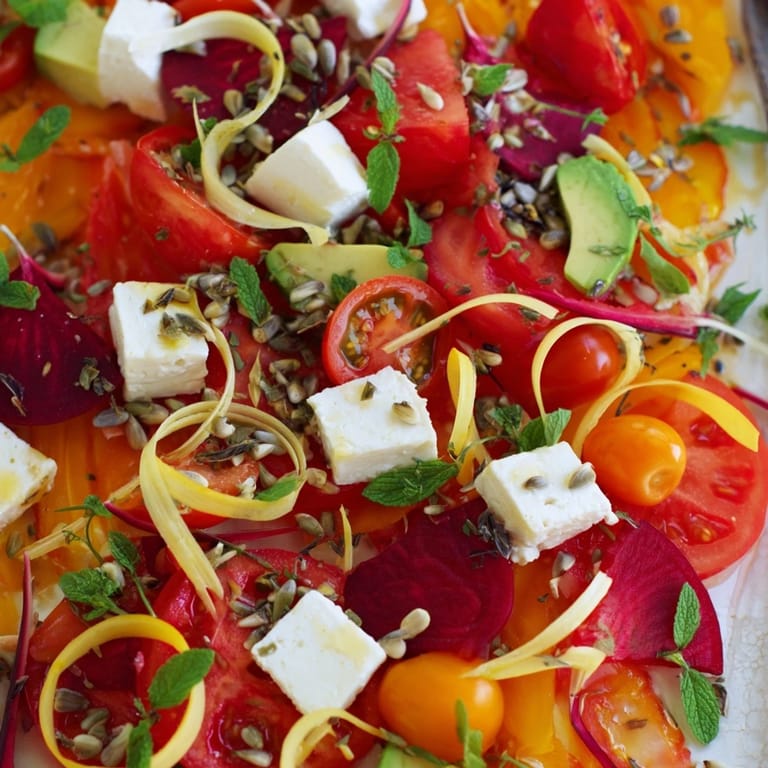
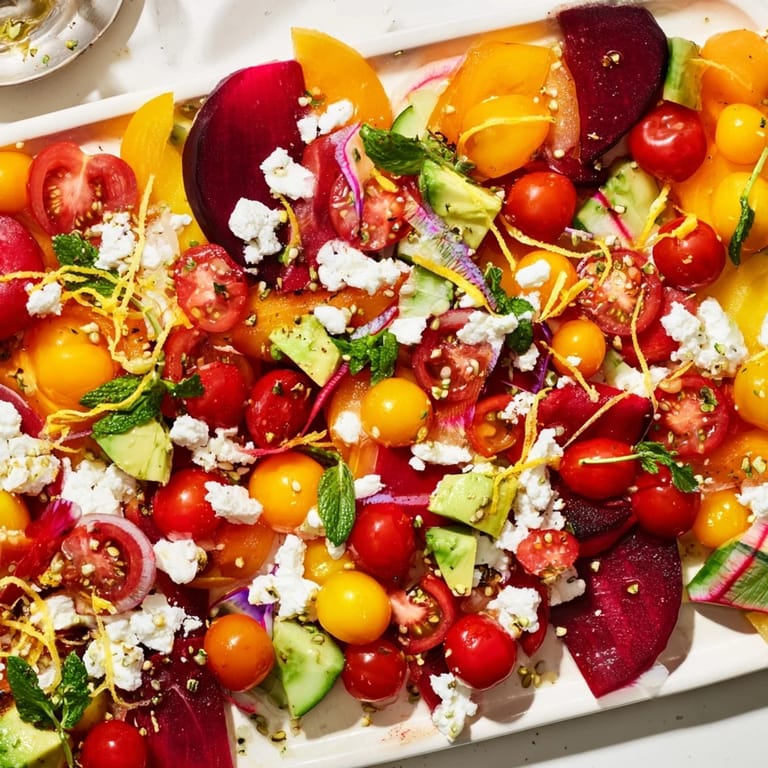
I made this for a dinner party last summer when my sister announced she'd gone vegetarian, and I wanted to show her that plant-based eating could be just as vibrant and exciting as anything else I'd cooked. Watching her face light up when she saw the platter—those pops of yellow tomato, the deep purple beet, the shocking pink watermelon all scattered like intentional brushstrokes—I realized I'd created something more than just salad. It became a statement about celebrating where she was in her journey.
Ingredients
- Cherry tomatoes (red and yellow), 1 cup halved: The sweet burst of yellow tomatoes against the deeper red ones creates visual drama that makes this salad sing—they're your primary color story, so choose the ripest ones you can find
- Golden beet, 1 small peeled and shaved: Shaving it thin lets the light shine through, creating jewel-like translucence that photographs beautifully and keeps the earthiness from overwhelming your palate
- Cucumber, 1 small sliced into ribbons: A mandoline is your friend here—ribbons catch the dressing differently than slices and add an elegant, almost delicate quality to the chaos
- Red radishes, 1/2 cup thinly sliced: Their peppery snap cuts through the sweeter elements and their bright pink rounds become little punctuation marks across the plate
- Watermelon, 1 cup cut into irregular cubes: The unexpected fruit element brings a cooling sweetness—cut them roughly instead of neatly, embracing the artistic imperfection
- Ripe avocado, 1 cubed: Adds creamy richness that softens the intensity of the raw vegetables; wait to cut it until just before serving so it stays bright green and buttery
- Mixed baby greens (arugula, baby spinach, frisée), 1 cup: The tender base that holds everything together—use whatever makes you happy, as long as it's fresh and delicate
- Fresh mint leaves, 2 tbsp torn: Not chopped, but torn by hand so the leaves bruise slightly and release their aromatic oils as you assemble
- Toasted pumpkin seeds, 1/4 cup: These add the crunch moment, and toasting them yourself intensifies their nutty flavor compared to raw ones
- Pomegranate seeds, 1/4 cup: Jeweled garnish that provides tartness and bursts of juice—they're as much about the eating experience as the visual one
- Crumbled feta cheese, 1/4 cup: Its salty tang provides an anchor point that makes all the bright flavors pop; the creamy crumbles nestle into the greens beautifully
- Extra-virgin olive oil, 3 tbsp: Quality matters here since it's not cooked—a fruity, peppery oil becomes part of the flavor story
- White balsamic vinegar, 1 tbsp: More delicate than dark balsamic, it adds brightness without staining your artistic arrangement with dark streaks
- Honey, 1 tsp: Just enough to coax the vinegar and oil into emulsion and add a whisper of sweetness
- Dijon mustard, 1/2 tsp: The secret emulsifier that makes everything cling together and adds subtle depth
- Salt and freshly ground black pepper, to taste: Taste as you go—the salt will brighten flavors while the black pepper adds visual texture to your creation
Tired of Takeout? 🥡
Get 10 meals you can make faster than delivery arrives. Seriously.
One email. No spam. Unsubscribe anytime.
Instructions
- Gather your materials like a painter at the canvas:
- Prepare every vegetable and fruit first, arranging them in separate bowls on your counter. This is your palette—take a moment to look at the colors you've created. The beauty of this salad starts before anything touches the plate.
- Create the foundation:
- Scatter your mixed baby greens and torn mint across your largest platter or shallow serving bowl in loose, generous clumps. Don't be neat about it. The greens are your canvas primer, the background that makes everything else sing.
- Let chaos be intentional:
- Now comes the fun part—splash and scatter your tomatoes, beet shavings, cucumber ribbons, radish slices, watermelon cubes, and avocado across the greens in an artfully wild arrangement. Let colors overlap and intermingle. Some sections should be dense with color, others more spaced out. Think of it like conducting an orchestra where every instrument plays its own note.
- Add the textural finale:
- Sprinkle the pumpkin seeds, pomegranate seeds, and crumbled feta over the top in an intentionally irregular pattern. These elements add depth and create little surprises in every forkful.
- Make your liquid art:
- In a small bowl, whisk together your olive oil, white balsamic vinegar, honey, Dijon mustard, salt, and pepper until you see the mixture begin to emulsify and lighten slightly. This is your dressing brushstroke.
- The final flourish:
- Drizzle the dressing generously across the salad in zigzags and splatters, truly mimicking brushstrokes. Some sections should be generously dressed, others more lightly touched. Drizzle is an art form here.
- Present with intention:
- Bring the platter to the table before anyone digs in. Let people admire the wild arrangement for a moment—there's something magical about food presented as art before it becomes a meal. Then let everyone mix it together however they like.
 Save to Pinterest
 The real magic happened when my grandmother, who grew up believing salad meant iceberg lettuce with bottled ranch dressing, looked at this plate and said, "This is art. I almost don't want to eat it." Almost. She did, and she went back for seconds, and in that moment I understood that food isn't just about nourishment—it's about creating moments that people remember.
The Philosophy of Artistic Eating
There's something deeply satisfying about plating your food like you're creating an installation piece. It slows you down. It makes you think about each element not just as nutrition but as color, texture, and intention. When you approach your salad this way—not as something to efficiently assemble but as something to thoughtfully compose—the eating experience transforms. You become more aware of flavors, of how things interact, of the joy in variety.
Making It Your Own
Here's the beautiful thing about a salad built on the principle of chaos and color—you're not locked into the exact ingredients. The framework is about contrast and brightness, so if you love roasted purple sweet potatoes, add them. If edible flowers make you happy, scatter them across the top. If you want to replace the feta with crispy tofu or vegan cheese, the structure holds strong. The only rule is that you include ingredients in different colors, textures, and flavor profiles so that every bite is a discovery.
Pairing and Serving
This salad wants to be the main event or the dazzling opener to something else. I find it pairs beautifully with a crisp Sauvignon Blanc that echoes the bright, fresh quality of the vegetables, or with sparkling water infused with citrus for a lighter option. The key is something that cleanses your palate and doesn't compete with the delicate, varied flavors happening on your plate. Serve immediately after dressing—the longer it sits, the more the greens will wilt and the colors will start to bleed into each other, which isn't bad, just different.
- If you want to make this ahead, keep all components separate and assemble just before serving—it takes only five minutes once everything's prepped
- This salad feeds four as a complete meal or six as a starter course with heartier elements to follow
- The most important thing is to trust your instincts about color balance and not overthink the arrangement—the imperfection is the point
 Save to Pinterest
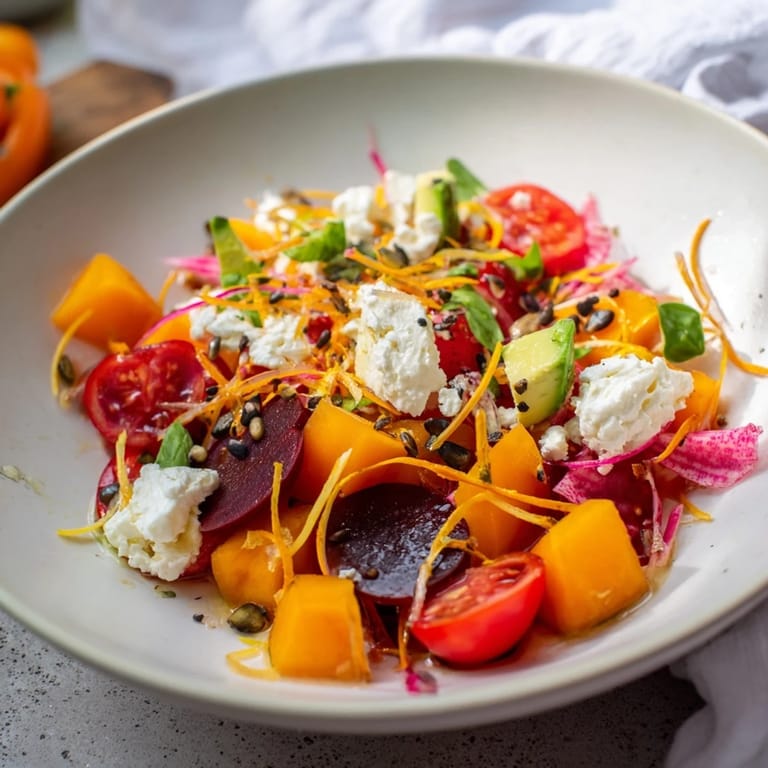
 This salad reminds me why I love cooking—it's a conversation between your hands and your creativity, between nourishment and joy. Every time you make it, it'll be different, and that's exactly as it should be.
Questions & Answers
- → What makes the salad visually unique?
The salad showcases an artistic layering of vibrant colors and textures, inspired by abstract expressionism, with ingredients scattered to mimic brushstrokes.
- → Can this salad be made dairy-free?
Yes, substituting the feta cheese with vegan alternatives can make it dairy-free without compromising flavor.
- → What ingredients add crunch to the dish?
Toasted pumpkin seeds and pomegranate seeds provide a crunchy texture that complements the fresh vegetables and fruits.
- → How is the dressing prepared?
The dressing is made by whisking together extra-virgin olive oil, white balsamic vinegar, honey, Dijon mustard, salt, and pepper to create a balanced tangy-sweet flavor.
- → Are there any allergen considerations?
The salad contains dairy from feta cheese and seeds that may be processed with nuts; gluten-free if all ingredients are certified.
- → What tools are recommended for preparation?
A sharp knife, vegetable peeler or mandoline, large platter, mixing bowl, and whisk streamline preparation and presentation.