 Save to Pinterest
 I remember the first time I encountered the Golden Ratio in nature—it was in a spiral seashell at a beach market, and I became obsessed with bringing that mathematical beauty into my kitchen. Years later, after countless dessert experiments, I discovered that the same proportions that make a Fibonacci spiral visually hypnotic could structure layers of mousse, sponge, and jelly into something that felt like edible art. The day I finally nailed it, my dinner guests fell silent when I placed this dessert in front of them, and I knew I'd created something special.
I'll never forget the wedding reception where I served this to a table of food critics and pastry chefs—they were analyzing every layer, discussing the mathematics of the spiral, and asking me about my training. The truth is simpler and sweeter: it's just a dessert made with intention, precision, and a deep respect for harmony.
Ingredients
- All-purpose flour (60 g): Creates the delicate, tender crumb that holds its shape without being dense—sifting is your friend here, and it truly makes a difference in how light the sponge feels
- Granulated sugar (60 g for sponge): Whisked with eggs until thick and pale, this is what gives the sponge its structure and subtle sweetness that won't compete with the mousse
- Large eggs (2): Room temperature eggs incorporate air more effectively, which is essential for that airy sponge that supports the layers above
- Unsalted butter, melted (30 g): Adds richness without overpowering—melted rather than creamed so it blends gently into the whisked eggs without deflating them
- Vanilla extract (1 tsp): A whisper of vanilla that reminds you this is a luxury dessert, not an everyday treat
- Fresh raspberry puree (110 g): The jewel of this dessert—use fresh or frozen raspberries blended smooth, and if you taste tartness you're tasting authenticity
- Powdered gelatin (4 g): Measured precisely because too much makes the jelly rubbery, too little makes it weep—I've learned this the hard way more than once
- Dark chocolate 70% (180 g): The higher cocoa percentage gives the mousse sophistication without bitterness, and it must be chopped fine so it melts evenly
- Heavy cream (140 ml for mousse, 40 ml for glaze): The secret to silky mousse is whipping only half of it and folding it in at the end—this keeps it light and airy
- White chocolate (100 g): For the glaze that seals the whole composition together and adds an elegant shine
- Edible gold leaf or dust: Completely optional, but it transforms the dessert from beautiful to ceremonial
Tired of Takeout? 🥡
Get 10 meals you can make faster than delivery arrives. Seriously.
One email. No spam. Unsubscribe anytime.
Instructions
- Prepare your mise en place:
- Gather every ingredient and tool before you start—this dessert requires precision, and having everything ready means you won't scramble when timing matters. Line your baking tray with parchment paper and set your oven to 180°C, giving it time to preheat while you organize your station.
- Build the sponge foundation:
- Crack your eggs into a clean bowl and whisk them with sugar for 3 to 4 minutes until the mixture becomes thick, pale, and ribbony—this is where the magic begins, as you're incorporating air that will make the sponge light. Sift flour and salt over the top and fold gently with a spatula, using a cutting motion that turns the bowl as you go, being careful not to deflate those precious air bubbles. Drizzle in the melted butter and vanilla, folding until just combined and the batter looks smooth.
- Bake the sponge:
- Spread the batter evenly across your prepared tray and place it in the preheated oven. After 10 to 12 minutes, it should be pale golden on top and spring back when you gently touch the center with your fingertip. Remove it, let it cool completely on the tray, then use a sharp knife and a ruler to cut it into 8 rectangles, each approximately 5 by 8 centimeters—these proportions matter because they're your canvas.
- Craft the raspberry jelly spiral:
- Sprinkle gelatin over cold water in a small bowl and let it bloom for exactly 5 minutes—this step is crucial because it allows the gelatin to hydrate fully and dissolve smoothly without lumps. Heat your raspberry puree and sugar together in a small saucepan until steaming but not boiling, then remove from heat and whisk in the bloomed gelatin until completely dissolved. Stir in lemon juice for brightness. Line a 16 by 16 centimeter tray with plastic wrap, pour in the mixture, and refrigerate until it sets to a firm jelly, about 1 to 2 hours.
- Cut the spiral with intention:
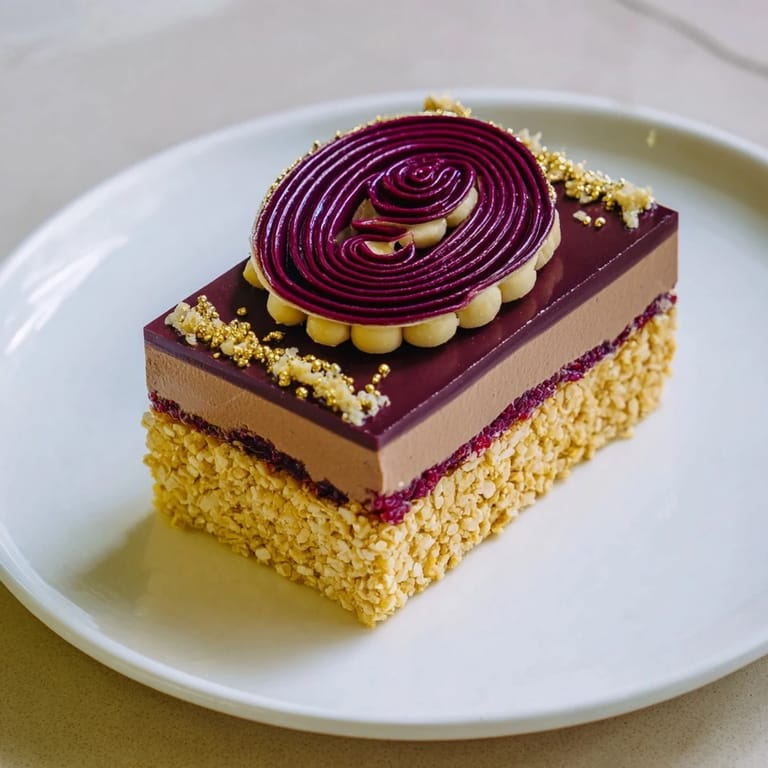
- Once set, turn the jelly out onto a cutting board and use a sharp knife or spiral cutter to create strips that start at 3 centimeters wide and gradually narrow to 1.8 centimeters, mimicking the Golden Ratio's natural curve. Take your time here—this is the visual heart of your dessert, and the gradual narrowing creates that satisfying mathematical beauty.
- Create the chocolate mousse:
- Chop your dark chocolate into small pieces and place it in a heatproof bowl. Set this bowl over a pot of gently simmering water, making sure the bottom doesn't touch the water, and stir occasionally until melted and smooth. In another bowl, whisk egg yolks with sugar until pale and thick, which takes about 2 minutes and signals they're ready to accept heat. Heat 70 milliliters of cream until steaming, then very slowly pour a little into the yolks while whisking constantly—this tempering step prevents the eggs from scrambling and is essential for a smooth mousse. Add the tempered yolks to the melted chocolate along with vanilla, stirring until silky.
- Fold in the whipped cream:
- Whip the remaining 70 milliliters of cream to soft peaks—you want it to hold a gentle shape but still look cloud-like, not stiff. Let the chocolate mixture cool for 2 minutes, then fold in the whipped cream with a spatula using that same careful cutting and turning motion, folding just until no white streaks remain. This step is where mousse transforms from chocolate mixture to something ethereally light.
- Assemble with precision:
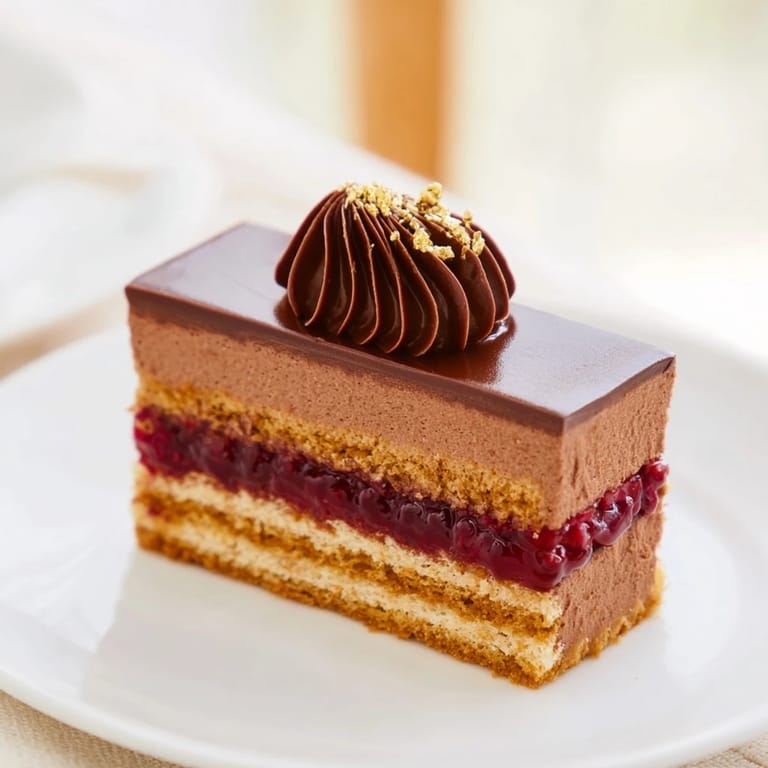
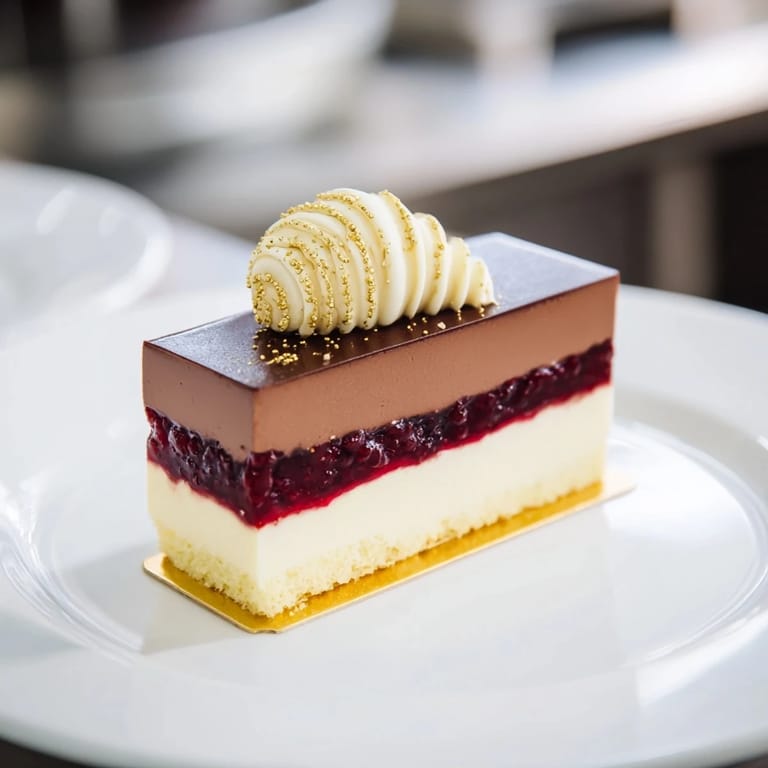
- Place a sponge rectangle on your serving plate or prepared surface. Using a piping bag fitted with a round tip, pipe a layer of mousse approximately 3 centimeters high on top of the sponge. Carefully arrange your raspberry jelly spiral on top, following the curve and starting with the widest end—let the spiral guide your hand as if you're creating a work of art, because you are.
- Finish with the white chocolate glaze:
- Chop white chocolate and place it in a bowl with cream, then gently melt together over the same water bath you used before, stirring until completely smooth. Let it cool for just 2 minutes until it reaches the right consistency—thick enough to coat but still pourable. Pour this glaze carefully over each assembled dessert, letting it flow down the sides and pool slightly on the plate. If using edible gold, dust or carefully apply it now, while the glaze is still slightly warm and slightly tacky.
- Chill and contemplate:
- Refrigerate the finished desserts for at least 2 hours before serving—this resting period allows all the layers to set and become distinct, and honestly, it gives you time to admire what you've created before sharing it with others.
 Save to Pinterest
 I served this dessert at my mother's birthday dinner, and she took one bite and closed her eyes—not because it tasted extraordinary, though it did, but because she recognized that I'd put thought and care into making something beautiful specifically for her. That's when I realized this recipe is really about translation: taking mathematical beauty and turning it into something that nourishes both body and spirit.
The Golden Ratio and Your Kitchen
The Fibonacci sequence appears in sunflowers, nautilus shells, and galaxies, and once you start seeing it, you can't unsee it. I became obsessed with this ratio not as an abstract concept but as a practical tool for creating desserts that feel inevitable rather than constructed. The spiral in this recipe isn't just decoration—it's a reminder that nature's proportions are inherently pleasing, and when we cook with intention and follow these patterns, we're not just making food, we're creating harmony on a plate. This dessert taught me that precision in cooking isn't cold or mechanical; it's actually the most loving thing you can do, because it means you're giving your full attention to every millimeter, every degree, every second of the process.
When to Make This Dessert
This is not a casual Tuesday-night dessert, and that's precisely why you should make it. Reserve it for moments when you want to mark an occasion, celebrate someone special, or challenge yourself in the kitchen. I've found that the act of creating something this deliberate shifts the entire meal into something ceremonial—the conversation slows down, phones disappear, and everyone becomes present. It's perfect for anniversaries, milestone celebrations, or those dinner parties where you want to say 'this gathering matters to me' without speaking a word.
Variations and Flavor Explorations
Once you've mastered the structure, this recipe becomes a template for countless variations that follow the same proportions and visual logic. I've made versions with mango puree for brightness, with white chocolate mousse for elegance, even with a dark chocolate jelly for richness. The key insight I've discovered is that you can swap fruits and chocolates freely as long as you respect the proportions and maintain the spiral integrity. Consider pairing the raspberry version with Moscato d'Asti, or try a passion fruit variation with crisp Champagne. The structure stays constant while the personality changes—it's like having a wardrobe where each piece is investment quality but styled differently each time.
- Mango puree brings tropical brightness and pairs beautifully with white chocolate mousse for a summer version
- Passionfruit creates sharper tartness that cuts through dark chocolate with elegant sophistication
- White chocolate mousse with dark chocolate jelly creates a beautiful color contrast while staying true to the original proportions
 Save to Pinterest
 Making this dessert is an act of intentionality in a world that often rushes. When you serve it, you're offering not just flavor and texture, but proof that beautiful things are possible in your own kitchen.
Questions & Answers
- → How is the Golden Ratio applied in this dessert?
Each layer is sized and arranged following the Golden Ratio spiral, ensuring natural visual balance and aesthetic harmony.
- → Can the fruit jelly be substituted?
Yes, raspberry puree can be replaced with mango or passionfruit puree for a different fruity twist.
- → What is the best way to assemble the layers?
Start with sponge rectangles, pipe a mousse layer, then carefully place the jelly spiral on top, repeating for each serving.
- → How long should the dessert be chilled?
Chill the assembled dessert for at least 2 hours to ensure the layers set properly and flavors meld.
- → What decorations enhance the dessert?
Edible gold leaf or dust adds an elegant and luxurious finishing touch to the glazed top layer.
- → Are there common allergens in this dessert?
It contains eggs, dairy, and gluten. Chocolate may contain traces of nuts depending on processing.